


Views: 0 Author: Site Editor Publish Time: 2025-10-02 Origin: Site


Are you struggling to install your heat pump thermostat? Improper wiring could lead to inefficiency and higher costs. In this guide, we'll cover the step-by-step process of wiring a heat pump thermostat. You'll learn how to wire it properly, ensuring your system runs efficiently and comfortably while avoiding common mistakes.
Correct thermostat wiring allows your heat pump to operate at peak efficiency, which directly affects both energy consumption and overall system performance. Proper wiring can significantly reduce energy bills by ensuring that the system is cycling properly. Incorrect or poorly executed wiring, however, can lead to inefficiency, excessive wear on the components, or even system failure. A well-wired system improves comfort by ensuring the heating and cooling cycles are activated at the right times, which is essential for maintaining a stable, comfortable indoor environment. Moreover, correctly wired systems extend the lifespan of your heat pump, saving you from costly repairs and replacements in the future.
A heat pump thermostat plays a crucial role in regulating the temperature within your home. It not only controls the temperature by managing the heating and cooling functions of the system but also has the capability to control auxiliary heating sources, which kick in when outdoor temperatures are extremely low. These auxiliary heat sources often include electric heat strips or gas furnaces. Understanding the wiring needs of a heat pump thermostat is critical, as it ensures that all modes of operation, including heating, cooling, and emergency heating, function as intended, delivering both comfort and efficiency.
Before diving into the wiring process, it's important to understand the tools and safety measures required to handle this task. Here's how you can get started:
A properly wired heat pump thermostat can significantly enhance system efficiency, resulting in lower energy bills and more consistent temperature regulation. On the other hand, incorrect wiring can lead to inefficiencies, such as the heat pump running constantly, or failing to turn on or off as needed. This can cause unnecessary wear and tear on the system, leading to premature breakdowns or costly repairs. Proper wiring also ensures that the heat pump's auxiliary heat functions correctly, keeping you warm during cold spells.
To wire your heat pump thermostat correctly, you will need a few essential tools:
Screwdrivers (flathead and Phillips): These are necessary to remove the thermostat cover and secure the wires into place.
Wire Strippers: Used to safely strip insulation from the wires without causing damage, ensuring a clean connection.
Voltage Tester: This tool helps confirm that there is no electrical current running through the system before you start working on it, ensuring your safety.
Heat Pump Thermostat Wiring Diagram: This is crucial for understanding where each wire should go, ensuring you make the correct connections as per the manufacturer's guidelines.
Safety is the top priority when working with electrical systems. Start by turning off the power at the breaker box to ensure that you're working with a de-energized system. Always double-check that the system is not receiving power using a voltage tester before proceeding with the wiring. This precaution will help you avoid electrical shocks, fire hazards, and damage to your system.
Now that you're prepared, it's essential to understand the different types of thermostat wires and their roles. This understanding will ensure that you make the correct connections, which is key for the optimal operation of your system.
Heat pump thermostats typically use the following wires, each serving a distinct purpose in regulating the system's functions:
Red (R): The power wire that provides 24V power to the system. This is the main power source for the thermostat.
White (W or Aux): Controls the auxiliary heating system, such as electric heat strips or gas furnaces, which are used in extreme cold.
Yellow (Y): Activates the cooling cycle. This wire sends a signal to the heat pump to begin cooling when the thermostat detects that the room is too warm.
Green (G): Powers the fan motor, which circulates air throughout the system to maintain consistent temperatures.
Orange (O) or Blue (B): Controls the reversing valve, which is responsible for switching the heat pump between heating and cooling modes. It determines whether the system is working to heat or cool the home.
Common (C): Provides continuous 24V power to digital and smart thermostats, allowing them to function properly. This wire is essential for thermostats with advanced features.
| Wire Color | Function |
|---|---|
| Red (R) | Power wire (24V from transformer) |
| White (W/Aux) | Controls auxiliary heating (electric heat strips) |
| Yellow (Y) | Activates the cooling cycle |
| Green (G) | Powers the fan motor |
| Orange (O) or Blue (B) | Controls the reversing valve (heating/cooling mode) |
| Common (C) | Provides continuous 24V power to digital thermostats |
Heat pumps can either be single-stage or dual-stage systems:
Single-Stage Heat Pump: This is a simpler setup that uses a single set of wiring to control both heating and cooling. It's typically used in smaller or less complex systems.
Dual-Stage Heat Pump: This system uses multiple stages for heating and cooling, which means it requires additional wiring for extra cycles, such as W2 for second-stage heating and Y2 for second-stage cooling. Dual-stage systems are common in larger homes or systems with more complex heating needs.
Correctly identifying the number of stages in your system is crucial to ensure you wire it properly for optimal performance.
In colder climates, your heat pump may need auxiliary heating to maintain comfort. Auxiliary heating, such as electric heat strips, kicks in when the outside temperature drops too low for the heat pump to extract sufficient warmth from the environment. For this system to work correctly, your thermostat must be wired to activate the auxiliary heating when necessary, ensuring that your home remains warm during extreme cold spells.
Let's break down the actual process of wiring your heat pump thermostat. This section will provide you with a clear, step-by-step guide.
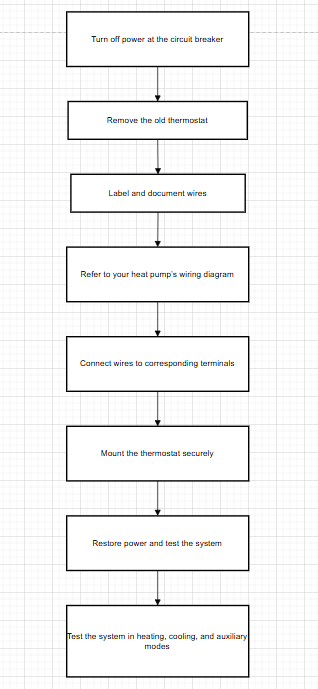
The first step is to turn off the power at the circuit breaker to avoid electrical hazards. Once the power is off, remove the cover of the existing thermostat to expose the wiring.
Before disconnecting any wires, take a photo of the current wiring setup for reference. Label each wire according to its terminal designation (e.g., R, Y, G). This will help you reconnect them correctly when installing the new thermostat.
Use the wiring diagram provided by your thermostat or heat pump manufacturer. This diagram will guide you on which wire connects to which terminal. Following this diagram is crucial to ensure that all components are connected properly and that your thermostat functions as intended.
Once the wires are labeled and the diagram is ready, begin connecting each wire to its corresponding terminal. Make sure each connection is secure, as loose connections can cause inefficiency or damage to the system.
After the wiring is complete, mount the thermostat onto the wall using the provided hardware. Make sure it's installed securely and that the wires are neatly arranged without being pinched.
Once everything is mounted, turn the power back on at the breaker box. Follow the thermostat's setup instructions to configure it for heating and cooling. Test the system by switching between heating, cooling, and auxiliary modes to ensure everything operates smoothly.
Even with proper installation, issues can sometimes arise. Here's how to troubleshoot common problems:
If your thermostat is not turning on, check the C-wire connection. Ensure the system's power is on and that the circuit breaker hasn't tripped. If everything is connected correctly, but the thermostat still won't power on, the issue may lie with the wiring or a malfunctioning thermostat.
If your heat pump is not maintaining a consistent temperature, verify that the O/B wire is connected properly to control the reversing valve. Also, make sure that the thermostat is set to the correct mode. Inconsistent performance can also be caused by loose wiring connections.
Short cycling occurs when the system repeatedly turns on and off. This is often due to incorrect wiring or a thermostat set to the wrong mode. Double-check all wiring connections and ensure the thermostat is configured correctly to prevent this issue.
In some cases, additional wiring configurations may be required.
Smart thermostats can greatly enhance the efficiency of your heat pump system by learning your schedule and adjusting the temperature accordingly. When wiring a smart thermostat, ensure that it is compatible with your heat pump system to avoid any wiring conflicts.
For dual-stage heat pumps, additional wiring is required to control both stages of heating and cooling. This typically involves adding wires like W2 and Y2 to handle the extra cycles. Proper wiring ensures that your heat pump can efficiently switch between the stages as needed.
Some heat pumps come with an emergency heat setting, which activates the backup heating system in case the primary system cannot handle the heating demand. This requires extra wiring to ensure that the auxiliary heat is triggered when necessary.
Once the wiring is done, maintaining the system's efficiency is essential to ensuring it operates smoothly for years to come.
Regular maintenance of your heat pump helps keep it running efficiently. Check the wiring connections periodically to ensure they are still secure. Additionally, clean or replace air filters as needed to keep the system running optimally.
Set up your smart thermostat to adjust the temperature based on your daily schedule. By doing so, the heat pump will only operate when necessary, reducing unnecessary energy consumption.
Properly wiring your heat pump thermostat is essential for ensuring efficiency and comfort. It ensures consistent heating and cooling while saving energy. By following this step-by-step guide, you can wire your thermostat with confidence and troubleshoot common issues. Always prioritize safety and follow manufacturer instructions to maintain long-lasting performance. GOODHEAT offers top-quality heat pump systems designed for durability and energy efficiency. Their products provide long-lasting value, ensuring reliable heating and cooling for various applications.
A: It ensures efficiency, saves energy, and avoids malfunctions.
A: Refer to the manufacturer's wiring diagram for correct connections.
A: Yes, but ensure safety and follow instructions.
A: Screwdrivers, wire strippers, voltage tester, and a wiring diagram.
A: Check the C-wire, circuit breaker, and connections.


