


Views: 0 Author: Site Editor Publish Time: 2026-10-04 Origin: Site


The most common cause of premature failure in modern hydronic heating systems isn't compressor breakdown. It is poor water quality silently destroying internal components. Plate heat exchangers feature exceptionally narrow channels designed for maximum thermal transfer. When exposed to installation debris, magnetite, biological fouling, or degraded antifreeze, these channels restrict flow. This plummets system efficiency, drives up energy costs, and risks catastrophic component failure. It also places severe stress on the refrigerant circuit.
Protecting this investment requires moving beyond basic operational checks. You cannot rely on factory settings to save a fouled heat exchanger. This guide breaks down the technical evaluation of water quality hardware, chemical treatments, and testing protocols. You will learn the exact steps necessary to secure long-term performance and maintain warranty compliance for your heating system.
Filtration is Non-Negotiable: Standard Y-strainers are insufficient for modern systems; combining them with magnetic sludge filters—or automatic self-cleaning filters for larger properties—is critical for protecting the plate heat exchanger.
Biological Fouling is a Hidden Threat: Low-temperature underfloor heating systems are breeding grounds for bacteria and algae, requiring dedicated biocide treatments alongside standard inhibitors.
Glycol is a Wear Item: Antifreeze degrades into corrosive acids over time. Regular refractometer and pH testing prevents internal system degradation.
Commissioning Sets the Baseline: Proper flushing and chemical dosing during initial setup dictate the system's lifespan and operational efficiency.
Maintenance Equals Efficiency: A strict water quality maintenance schedule prevents the 15-20% efficiency drops commonly associated with fouled heat exchangers.
A healthy hydronic circuit operates within strict parameters. Optimal flow rates ensure heat moves efficiently from the unit into the property. A stable delta-T indicates proper thermal transfer across the heat exchanger. Neutral pH levels prevent internal corrosion. When these baseline metrics drift, the entire system suffers. Water quality directly controls these variables, dictating how hard the mechanical components must work to satisfy the thermostat.
Modern heating systems rely on brazed plate heat exchangers. These components use a micro-channel architecture with stamped chevron patterns to maximize surface area and create turbulent flow. The gaps between plates often measure just one or two millimeters. This tight tolerance makes them incredibly efficient but highly vulnerable to blockages. Even millimeter-scale fouling disrupts thermal transfer. Debris acts as an insulator. It blocks the flow of water and traps heat where it does not belong. This restriction causes high-pressure lockouts and forces the system to shut down to protect itself.
Poor water quality triggers a cascading failure effect that reaches far beyond the water pipes. It starts with restricted water flow across the primary heat exchanger. Poor water flow leads to poor heat dissipation. The heat pump generates thermal energy, but the water cannot carry it away fast enough. This forces the compressor to work harder to overcome the rising condensing pressure. Discharge temperatures elevate rapidly. High operating temperatures break down compressor oil and threaten the longevity of modern refrigerants. Protecting the water circuit is the only way to protect the refrigerant circuit from premature death.
Ignoring water quality carries heavy operational penalties. Circulation pumps must work harder to push fluid through restricted channels, significantly increasing pump energy consumption. The Coefficient of Performance (COP) drops as the system struggles to transfer heat. A fouled heat exchanger can easily cause a 20% drop in overall efficiency, inflating monthly utility bills. Furthermore, manufacturers monitor these failure modes through onboard diagnostics. Improper fluid conditions routinely void manufacturer warranties. You bear the full financial burden of replacing a ruined air-to-water heat pump if you neglect water treatment.
The lifespan of a heating system is determined on day one. Proper setup prevents years of operational headaches. You must establish a clean, chemically balanced hydronic circuit before turning the unit on for the first time.
You cannot connect a new heat pump to dirty pipework. A power flush is mandatory prior to final connection. This process involves connecting a dedicated flush cart and forcing high-velocity water through the individual circuits. It removes installation debris, flux, solder, and swarf. Legacy pipework holds decades of accumulated sludge and rust flakes. New pipework contains manufacturing oils and plastic shavings. Power flushing strips these contaminants out. You must use dedicated chemical cleaners during this phase to break down stubborn deposits, reversing the flow direction periodically to dislodge trapped debris in radiator valves and manifold flow meters.
Source water is rarely perfect. You must test the fill water before charging the system. Check for hardness, Total Dissolved Solids (TDS), and pH. Hard water introduces scale, which coats the heat exchanger and acts as a thermal insulator. High TDS indicates excessive dissolved minerals that can precipitate out of solution. Once you verify the water quality, you must introduce chemical protection. Corrosion inhibitors coat the internal metals to prevent rust. Biocides are equally critical. Closed-loop floor heating systems operate at low temperatures. This creates a perfect breeding ground for organic growth. Biocides kill these organisms before they form blockages.
Contractors often skip chemical cleaning during heat pump commissioning to save time. This is a fatal error that guarantees future breakdowns. You must verify that proper commissioning standards were followed. Request documentation showing the exact chemicals used and the dosing ratios. Ask for the baseline TDS and pH readings. Compare these numbers against the manufacturer guidelines. Documenting this process protects your warranty and ensures the system starts with a clean slate.
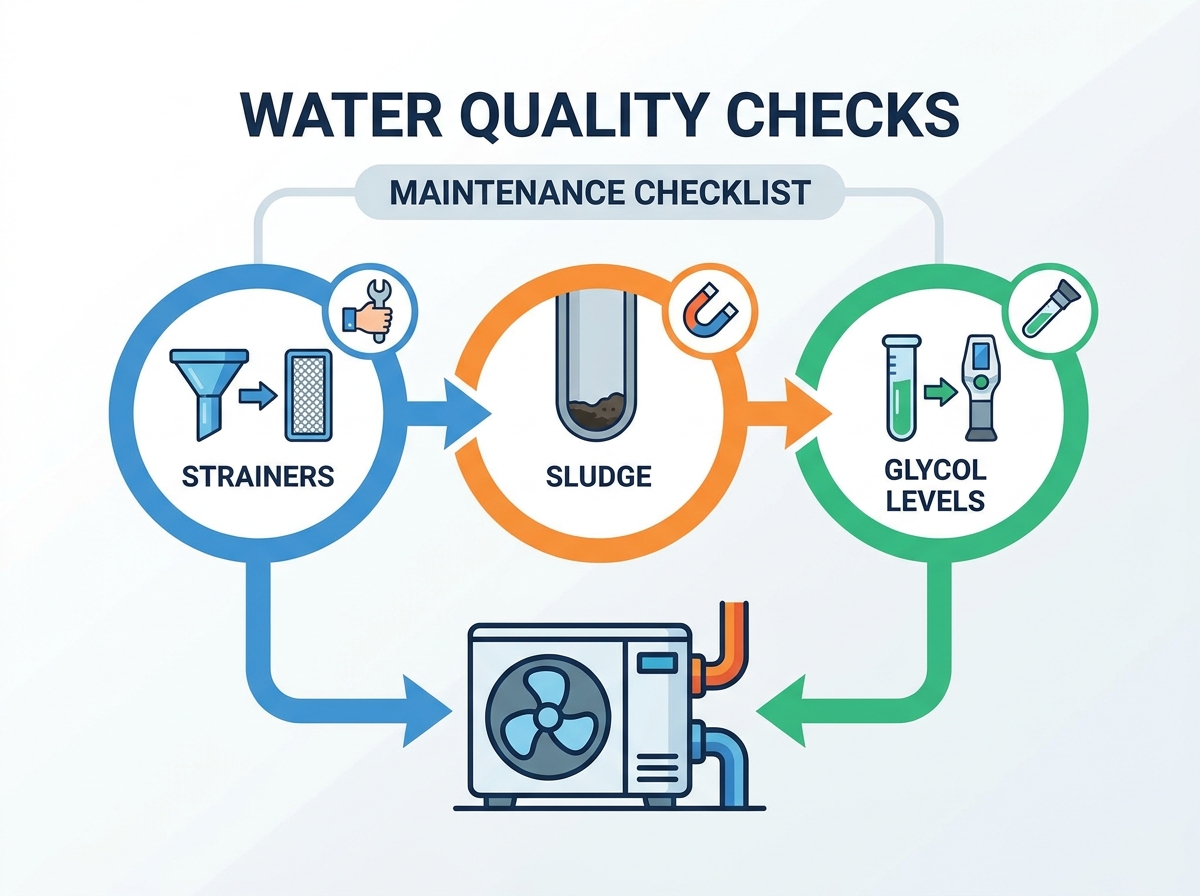
Chemical treatments prevent new debris from forming. Filtration removes the debris already circulating in the system. You need a robust physical barrier to protect the plate heat exchanger from suspended solids.
Modern hydronic filtration falls into several categories. Inline Y-strainers provide basic mechanical filtration. Magnetic filters capture ferrous metals. Cyclonic dirt separators use centrifugal force to drop particles out of suspension. Automatic self-cleaning filters handle high-volume debris without manual intervention. Each serves a specific purpose in the hydronic circuit and they are often used in combination.
You cannot rely on a single filtration method. Y-strainers and magnetic filters do different jobs and target different types of contamination.
Y-Strainers: These devices use a stainless steel mesh to catch large particulate matter. Mesh sizing is measured in microns. A 400-micron to 800-micron mesh is standard for heat pump protection. You must place the Y-strainer on the return line. It stops pipe scale, plastic shavings, hemp, and solder from entering the unit.
Magnetic Filters: Standard mesh cannot catch microscopic iron oxide. Magnetite particles are incredibly small, often under 5 microns. They pass right through a Y-strainer. Magnetic filters use powerful neodymium magnets placed directly in the flow path to pull this black sludge out of the water. Capturing magnetite is non-negotiable because it aggressively coats the narrow channels of the heat exchanger and destroys the mechanical seals inside circulation pumps.
Standard residential filters require manual cleaning. This becomes impractical for collective buildings or commercial applications. Highly contaminated legacy pipework also overwhelms standard filters quickly, requiring daily blowdowns. Automatic or self-cleaning water filters solve this problem. Rotorflush systems and cyclonic automated purge valves monitor pressure drops across the filter body. When the filter gets dirty, it automatically opens a motorized valve and flushes the debris to a drain. This upgrade ensures continuous protection without constant manual labor.
Filter placement dictates its effectiveness. You must install filtration on the return pipework. Place it immediately before the heat pump. This ensures the water is as clean as possible right before it enters the vulnerable heat exchanger. Size the filter to match the pipe diameter. Undersized filters restrict flow, increase pressure drop, and cause the circulation pump to overwork, which triggers flow-rate faults on the main controller.
Filters only work if you clean them. A clogged filter is just as damaging as a fouled heat exchanger. You must perform this process without introducing air into the closed-loop system. Air causes corrosion and creates airlocks in the pipework.
Isolate the filter body using the upstream and downstream isolation valves.
Remove the magnetic sheath or core to allow the trapped magnetite to fall into the lower sump.
Open the blowdown valve to flush the accumulated black sludge and loose debris into a bucket.
Remove the mesh screen, inspect it for tears, and rinse it under clean water.
Reassemble the unit, close the blowdown valve, and reinsert the magnet.
Open the isolation valves slowly and verify the system pressure on the expansion vessel gauge.
Comparison of Hydronic Filtration Types
Filter Type | Primary Target | Maintenance Requirement | Best Application |
|---|---|---|---|
Y-Strainer | Large debris, solder, swarf | Manual cleaning (Bi-annual) | Mandatory baseline protection |
Magnetic Filter | Microscopic magnetite, iron oxide | Manual wiping (Bi-annual) | Systems with steel radiators or pumps |
Cyclonic Separator | Suspended non-magnetic dirt | Manual blowdown (Annual) | High-flow residential systems |
Automatic Purge Filter | All heavy particulate matter | Automated (Self-cleaning) | Commercial or collective buildings |
Water is a universal solvent. When trapped in a closed loop with mixed metals, it becomes highly reactive. You must actively manage the chemical composition of the fluid to prevent system degradation and maintain thermal transfer efficiency.
Sludge does not appear by magic. It is the result of a chemical reaction. Hydronic systems contain mixed metals like copper, steel, brass, and aluminum. When water interacts with these metals, galvanic corrosion occurs. Oxygen accelerates this process. Oxygen ingress happens through micro-leaks, faulty auto-air vents, or non-barrier PEX tubing. The resulting iron oxide mixes with water to form a thick, abrasive black paste known as magnetite. This sludge settles in low-flow areas, blocks radiator valves, and coats heat transfer surfaces.
Biological fouling is a massive threat to modern heating systems. Air-to-water units operate at lower flow temperatures than traditional boilers. Underfloor heating loops often run between 30°C and 40°C. This creates the perfect closed environment for bacterial and algal growth. These organisms multiply rapidly. They form thick, slimy biofilms that coat the inside of the PEX tubing. Biofilm acts as a thermal insulator and physically blocks the flow of water. It ruins the efficiency of the floor heating system and causes the heat pump to short-cycle.
You must evaluate and select the correct central heating inhibitors. Inhibitors alter the water chemistry to stop galvanic corrosion. They form a microscopic protective layer over the internal metals. Biocides work alongside inhibitors to kill organic growth. You must dose the system according to the total water volume, typically around 1% concentration depending on the brand. Under-dosing provides zero protection. Over-dosing can damage rubber seals and increase fluid viscosity. You must check inhibitor concentration levels annually using dedicated titration test kits.
Fouling presents clear warning signs before catastrophic failure occurs. Cold spots in underfloor heating indicate biofilm blockages. Noisy circulation pumps suggest magnetite is grinding against the impeller and destroying the ceramic bearings. Reduced performance in domestic hot water (DHW) indirect cylinder coils points to scale buildup on the coil surface. Frequent flow-rate errors on the controller mean the plate heat exchanger is restricting water movement. Address these symptoms immediately to prevent permanent damage.
Monobloc units sit outside the thermal envelope of the building. The water inside them will freeze and split the heat exchanger during a power outage in winter. Antifreeze is necessary, but it introduces complex chemical challenges that require strict monitoring.
You must choose between two primary antifreeze types. Ethylene glycol offers excellent specific heat capacity. It transfers thermal energy efficiently and has lower viscosity. However, it is highly toxic. Many local codes ban it for residential use due to the risk of cross-contaminating domestic water through a failed DHW coil. Propylene glycol is non-toxic and environmentally safe. It is the standard for residential applications. The trade-off is a slightly lower thermal efficiency and higher viscosity. The circulation pump must work slightly harder to move propylene glycol, and the system requires a higher flow rate to achieve the same heat transfer.
Glycol is not a lifetime fluid. It is a wear item. Antifreeze degrades when exposed to high stagnation temperatures or oxygen. The chemical breakdown results in a drop in pH. The fluid turns from alkaline to acidic. It forms corrosive organic acids. Degraded glycol is worse than no glycol at all. It aggressively attacks copper pipework, brass fittings, and rubber O-rings. You must monitor the fluid health to prevent internal system degradation.
Testing glycol requires specific tools. Visual inspections are useless, as the dye color does not indicate chemical health. You must measure the physical and chemical properties of the fluid.
Refractometer Testing: Hydrometers are inaccurate for modern hydronic fluids. You must use a refractometer. This optical tool measures how light bends through the fluid on a Brix scale. It verifies the exact freeze-point protection. Calibrate the tool with distilled water first. Place a few drops of system fluid on the lens, close the daylight plate, and read the scale. Adjust the concentration if the freeze point is too high.
pH and Reserve Alkalinity Monitoring: Glycol contains a corrosion inhibitor package. Reserve alkalinity measures how much of this package remains to buffer acids. Use digital pH meters or high-quality test strips. Fresh glycol has a pH between 8.0 and 9.5. If the pH drops below 7.5, the fluid is turning acidic. At this point, a complete fluid replacement and system flush is financially justified over simple top-offs.
Consistency prevents failure. A strict maintenance schedule catches minor issues before they destroy the heat exchanger. Follow this protocol to maintain peak efficiency and protect your capital investment.
Perform these basic checks twice a year. They require minimal tools but provide massive protection against flow restrictions.
Conduct a visual inspection of all exposed pipework, manifold connections, and valves for micro-leaks.
Perform a strainer blowdown to clear large debris and pipe scale.
Isolate and clean the magnetic filter core to remove accumulated magnetite.
Check automatic filter purge valves for proper operation and clear drain lines.
Verify system pressure on the expansion vessel gauge and top up if it falls below 1.5 bar.
Hire a qualified technician for the annual service. They possess the tools to verify the chemical health of the system. This forms the core of your heat pump maintenance checklist.
Execute comprehensive glycol concentration testing using a calibrated refractometer.
Test the fluid pH with a digital meter to ensure it remains alkaline (above 7.5).
Verify inhibitor and biocide levels via titration or chemical test strips.
Measure the flow rate across the primary heat exchanger using the onboard controller diagnostics.
Verify the delta-T across the DHW indirect coil to confirm thermal transfer is not blocked by scale.
Preventative maintenance requires a small annual investment. Replacing a fouled heat pump unit requires massive capital expenditure. A fouled system also inflates your monthly energy bills by forcing the compressor to run longer cycles at higher condensing temperatures. Preventative maintenance contracts offer an excellent return on investment. They lock in system efficiency, validate your warranty, and extend the operational lifespan of the equipment by a decade or more.
An air-to-water heat pump is only as efficient and reliable as the water circulating through it. You cannot ignore hydronic health and expect long-term performance. The micro-channel architecture of modern heat exchangers demands pristine fluid conditions to transfer thermal energy effectively.
Selecting the right filtration hardware is your primary defense. A mandatory magnetic filter paired with a Y-strainer protects residential units. Automatic filters secure larger commercial systems. You must pair this hardware with premium, inhibited glycol and dedicated biocides to stop internal corrosion and biological fouling at the source.
Take immediate action to protect your system:
Review your original commissioning documentation to verify chemical dosing and baseline pH levels.
Schedule a baseline water quality test with a technician to check current inhibitor concentrations.
Upgrade your system's filtration by adding a magnetic dirt separator during your next service interval.
Purchase a refractometer to independently verify your glycol freeze protection before winter temperatures arrive.
A: You must check the glycol annually. Use a refractometer to verify the freeze point protection. Test the pH to ensure the fluid has not degraded into corrosive acids. Replace the fluid entirely if the pH drops below 7.5 or if the reserve alkalinity is depleted.
A: You need a dual approach. Install a Y-strainer to catch large debris like solder and plastic shavings. Pair it with a magnetic filter to capture microscopic magnetite. For collective buildings or highly contaminated systems, automatic self-cleaning filters are highly recommended.
A: Yes. Magnetite sludge clogs the narrow channels of the plate heat exchanger. This restricts water flow, causing flow faults and high-pressure lockouts. The poor heat dissipation forces the compressor to overheat, ultimately leading to catastrophic compressor failure.
A: Heat pump floor heating systems operate at low temperatures, typically between 30°C and 40°C. This creates an ideal environment for algae and bacteria to thrive. Biocides prevent these organisms from forming thick biofilm blockages inside the tubing.
A: You must perform a power flush before final connection. This involves pumping high-velocity water and chemical cleaners through the circuits to remove installation debris, flux, and legacy sludge. Once clean, you flush with fresh water before adding inhibitors and biocides.
A: A clogged strainer severely restricts water flow. You will experience reduced heating capacity, frequent flow-rate errors on the controller, and high-pressure lockouts. The circulation pump will also consume more energy as it struggles to push water through the blockage.
A: Even with plastic PEX piping, your system contains ferrous metals. Circulation pumps, motorized valves, expansion vessels, and indirect cylinder coils contain steel or cast iron components. These parts generate rust and magnetite, which must be captured by a magnetic filter.


