


Views: 0 Author: Site Editor Publish Time: 2026-08-04 Origin: Site


Mismatched regional HVAC standards cause significant engineering friction during equipment specification. US manufacturers rely heavily on British Thermal Units (BTU). International markets and modern electrical standards utilize kilowatts (kW). Capacity miscalculations during the specification phase lead to catastrophic system sizing errors. Incorrectly sizing a heat pump results in equipment short-cycling, inadequate thermal loads, elevated operational costs, and voided warranties. Relying on inaccurate conversions compromises the entire mechanical design of a building. This guide serves as the definitive framework to accurately convert BTU/hr to kW, decode MBH terminology, and align thermal capacity metrics for precise equipment selection and procurement.
The Baseline Constant: The foundational conversion metric is 1 kW = 3,412.14 BTU/hr; precision here prevents compounding errors in large-scale commercial applications.
Decoding MBH: MBH stands for 1,000 BTU/hr (using the Roman numeral 'M' for thousand), a common source of calculation errors when confused with millions (MMBTU).
Thermal vs. Electrical kW: Evaluating a heat pump requires strictly separating thermal output capacity (kW) from electrical input power (kW), bridged by the system's Coefficient of Performance (COP).
Specification Alignment: Standardizing capacity units early in the procurement process streamlines the comparison of domestic and international HVAC equipment, ensuring compliance with local energy codes.
The British Thermal Unit per hour (BTU/hr) represents the traditional imperial measure of heat transfer rate. It defines the amount of energy required to heat or cool one pound of water by one degree Fahrenheit within an hour. This unit remains the standard in North American residential and commercial HVAC markets. You will see it stamped on almost every domestic furnace, boiler, and air handler nameplate.
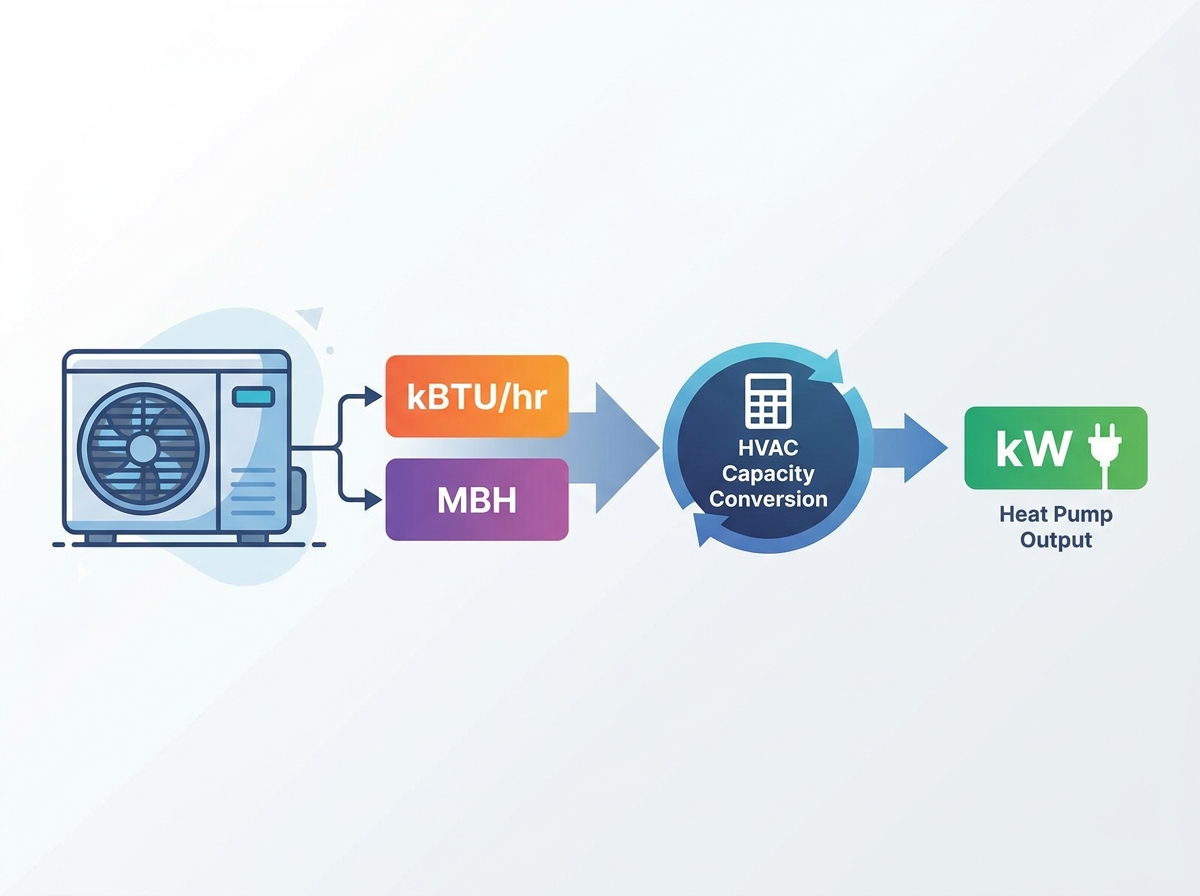
The term kBTU/hr (kilo-BTU) simply denotes 1,000 BTU/hr. It provides a more manageable number for larger systems without changing the underlying metric. Engineers frequently use kBTU/hr to simplify load calculations on extensive commercial projects. Writing 500 kBTU/hr is much cleaner on a mechanical schedule than writing 500,000 BTU/hr.
MBH also signifies one thousand BTU/hr, utilizing the Roman numeral 'M' for thousand. A common novice error involves reading the 'M' as 'Million'. This leads to sizing equipment 1,000 times larger or smaller than required. Millions of BTUs are correctly denoted as MMBTU. When you read a boiler submittal that says 199 MBH, it means 199,000 BTU/hr. Misinterpreting this on a job site leads to immediate procurement disasters.
The kilowatt serves as the SI (metric) unit of power. It represents the rate of energy transfer equivalent to 1 Joule per second. While commonly associated with electricity, kW accurately measures both heating and cooling capacities in thermal dynamics. European and Asian manufacturers use thermal kW as their baseline metric.
Global manufacturers and modern engineering schematics default to kW for thermal capacity. Using kW creates a universal standard that simplifies international trade, equipment comparison, and integration with modern electrical grids. When you review a VRF system submittal from a Japanese manufacturer, the outdoor unit capacity will be listed in kW. You must translate this accurately to match your building's load profile.
Tons of Refrigeration historically measure the rate of heat transfer required to melt one ton of pure ice in 24 hours. One Ton equals exactly 12,000 BTU/hr, which converts to 3.517 kW. This legacy unit remains prevalent in cooling capacity discussions. Field technicians still refer to a 60,000 BTU/hr condenser as a "5-ton drive."
Horsepower (HP) frequently appears in compressor and fan motor specifications. Confusing electrical HP with thermal output limits design accuracy. HP strictly measures mechanical work or electrical power input, not the thermal energy moved by the system. A 5 HP compressor motor does not produce 5 HP of cooling. It drives a refrigeration cycle that moves a specific amount of thermal kW.
Converting imperial thermal units to metric requires a specific constant. To convert BTU/hr to kW, use the formula: Capacity in kW = Capacity in BTU/hr ÷ 3,412.14. This calculation provides the exact thermal output in metric units. If you have a 36,000 BTU/hr mini-split, dividing by 3,412.14 gives you 10.55 kW of thermal capacity.
To reverse the process, use the formula: Capacity in BTU/hr = Capacity in kW × 3,412.14. This allows engineers to translate international equipment specifications back into familiar North American metrics. If a European chiller provides 50 kW of cooling, multiplying by 3,412.14 reveals a capacity of 170,607 BTU/hr.
Acceptable rounding tolerances vary by application. Residential specifications often round the constant to 3,412. Commercial specifications require higher precision. They typically utilize 3,412.14 or 3,412.142 to prevent compounding errors across massive thermal loads. A rounding error on a 500-ton chiller plant can result in a capacity shortage of several kilowatts.
Converting MBH requires addressing the thousand multiplier. The two-step formula is: Capacity in kW = (MBH × 1,000) ÷ 3,412.14. This method ensures the base units align before applying the conversion constant. Always expand the MBH to raw BTUs first if you are building a calculation spreadsheet from scratch.
To prevent algebra errors, use the direct shortcut formula: Capacity in kW = MBH × 0.29307. Conversely, MBH = kW × 3.41214. These shortcuts streamline field estimations. When standing on a roof looking at a 120 MBH rooftop unit, multiplying by 0.293 gives you a fast estimate of roughly 35 kW.
Let us walk through a practical example. Consider converting a 60 MBH boiler. Using the shortcut, 60 MBH × 0.29307 equals 17.58 kW. This quick calculation allows rapid assessment of equipment suitability against a metric load calculation.
Tons (Cooling) | BTU/hr | MBH | kW (Thermal) |
|---|---|---|---|
1.0 | 12,000 | 12 | 3.517 |
2.0 | 24,000 | 24 | 7.034 |
3.0 | 36,000 | 36 | 10.551 |
4.0 | 48,000 | 48 | 14.068 |
5.0 | 60,000 | 60 | 17.585 |
7.5 | 90,000 | 90 | 26.377 |
10.0 | 120,000 | 120 | 35.169 |
15.0 | 180,000 | 180 | 52.753 |
20.0 | 240,000 | 240 | 70.337 |
Rounding errors in conversion can easily push a specification into the wrong equipment tier. A miscalculation of just a few percentage points might result in selecting a 4-ton unit when a 3.5-ton unit is required. Mechanical engineers rely on exact load calculations to match sensible and latent heat ratios.
Over-sizing equipment leads to rapid cycling. The compressor turns on, blasts cold air, satisfies the thermostat quickly, and shuts off. This prevents adequate humidity control because the coil does not run long enough to extract moisture. It also accelerates compressor wear. Under-sizing results in the system running continuously while failing to meet design temperature setpoints during peak load conditions.
Cross-referencing Asian or European data sheets against US load calculations requires meticulous conversion. Foreign submittals use native kW. US load calculations use native BTU/hr. Evaluating these dimensions ensures the selected equipment matches the building's thermal demands exactly.
Standardizing units is a strict requirement for apples-to-apples vendor comparison. Without a common metric, evaluating the cost-per-capacity or efficiency between competing domestic and international brands becomes impossible. You cannot compare a 140 MBH domestic unit against a 45 kW imported unit without doing the math first.
Accurate kW conversions directly impact electrical infrastructure planning. Knowing the precise thermal and electrical kW determines proper panel sizing, wire gauge selection, and breaker requirements. The Minimum Circuit Ampacity (MCA) and Maximum Overcurrent Protection (MOP) rely on accurate electrical kW data, which is derived from the thermal capacity and efficiency ratings.
Local energy codes and rebate programs frequently set strict kW or BTU thresholds. Accurate conversion ensures compliance with these regulations. It secures necessary financial incentives for the project owner. If a utility rebate requires a minimum of 15 kW thermal output at 5 degrees Fahrenheit, your conversion math must be flawless to qualify.
The most common point of confusion in equipment evaluation involves distinguishing between electrical kW and thermal kW. Electrical kW represents the electricity the unit consumes from the grid. This power operates the compressor, circuit boards, and fan motors.
Thermal kW represents the actual heat energy the system moves into or out of the building. Because refrigeration cycles transfer heat rather than generate it through raw electrical resistance, the thermal kW output significantly exceeds the electrical kW input. A unit might draw 2 kW of electricity to move 8 kW of heat.
The Coefficient of Performance (COP) defines the ratio of useful heating or cooling provided to the electrical work required. The formula is Thermal kW ÷ Electrical kW = COP. A higher COP indicates greater system efficiency. A COP of 4.0 means the system outputs four units of heat for every one unit of electricity consumed.
To determine electrical load requirements when manufacturers only provide thermal MBH specifications, first convert the thermal capacity to kW. Then, divide that thermal kW by the system's stated COP to find the estimated electrical kW input. If you have a 120 MBH unit (35.17 thermal kW) with a COP of 3.5, the electrical draw is roughly 10.05 kW.
Thermal Capacity (MBH) | Thermal Capacity (kW) | System COP | Estimated Electrical Input (kW) |
|---|---|---|---|
36 | 10.55 | 3.0 | 3.51 |
60 | 17.58 | 3.5 | 5.02 |
120 | 35.17 | 4.0 | 8.79 |
240 | 70.34 | 3.2 | 21.98 |
Interpreting the 'M' in MBH as million rather than thousand poses a severe risk. This error leads to specifying equipment 1,000 times too large or too small. Ordering a 2,000,000 BTU/hr boiler when you needed a 2,000 BTU/hr space heater destroys the project budget and mechanical design.
To mitigate this risk, mandate the use of kBTU/hr or kW in all internal documentation. Eliminating Roman numeral ambiguity prevents catastrophic sizing failures during the procurement phase. Train junior engineers to flag any submittal using 'M' and verify the intended scale immediately.
Generic online converters often show slightly conflicting values by using different constants. Some use 3,412. Others use 3,412.142. These minor discrepancies cause verification issues and delays during formal submittal reviews. An inspector might reject a schedule if the math does not tie out perfectly.
Establish a standard project constant of 3,412.14 in all master spreadsheets. Standardizing this metric eliminates compounding rounding errors. This is especially critical in multi-ton VRF system designs where dozens of indoor units roll up to a single outdoor condenser.
Converting nominal BTU/hr to kW does not account for capacity degradation at extreme ambient temperatures. Nominal ratings only reflect performance under standardized, moderate testing conditions (usually 47°F for heating). A unit rated for 10 kW at 47°F might only deliver 6 kW at 5°F.
Always run conversions on the manufacturer's extended performance data tables. Use the specific winter or summer design temperatures for the project location. Determine the actual thermal capacity the system will deliver under peak load, then apply your conversion math to that derated number.
Accurate BTU/hr to kW conversion is the foundation of reliable HVAC equipment selection, but successful system design requires more than a simple mathematical calculation. Understanding the relationship between thermal capacity, electrical input, COP, and real-world operating conditions allows engineers to avoid costly oversizing, undersizing, and performance issues.
Standardizing capacity measurements across BTU/hr, MBH, and kW creates a common language for evaluating domestic and international equipment options. However, the final selection must also consider local design temperatures, efficiency ratings, building loads, and long-term operating requirements rather than relying only on nominal nameplate values.
By applying consistent conversion methods and validating equipment performance data, contractors, engineers, and facility owners can make more confident procurement decisions while improving system reliability and energy efficiency.
A: Divide the BTU/hr value by 3,412.14 to get the equivalent thermal capacity in kilowatts. This formula provides accurate metric sizing for thermal loads.
A: Multiply the kW value by 3,412.14 to calculate the equivalent BTU/hr capacity. This translates metric specifications back into standard imperial units.
A: MBH stands for one thousand British Thermal Units per hour. The 'M' represents the Roman numeral for one thousand, not million.
A: Kilowatts measure the rate of energy transfer. This applies equally to electrical power consumed and thermal energy moved by an HVAC system.
A: COP is the ratio of thermal kW output to electrical kW input. It bridges the gap between the heat provided and the electricity consumed.
A: There is no mathematical difference. Both kBTU/hr and MBH represent 1,000 BTU/hr. They are simply different naming conventions for the exact same thermal capacity measurement.


