


Views: 0 Author: Site Editor Publish Time: 2026-07-28 Origin: Site


Misinterpreting energy and power units during HVAC procurement routinely leads to undersized equipment, compromised comfort, or unexpected electrical infrastructure costs. Spec sheets for modern HVAC equipment utilize a fragmented mix of Imperial and Metric units. Decision-makers are forced to reconcile thermal capacity (often in BTU/hr) with electrical input (in kW) and projected operating consumption (in kWh) without a standardized baseline. When you look at a manufacturer submittal, you might see heating capacity listed in one unit and power draw in another. To accurately evaluate quotes, compare system efficiencies, and verify electrical panel requirements, buyers must master the exact distinctions between these units. This guide provides a definitive framework for translating technical specifications into real-world performance and operational outcomes. Understanding these metrics prevents costly installation errors and ensures the selected equipment matches the actual thermal load of the building.
Power vs. Energy: kW and BTU/hr measure the rate of energy transfer (Power), while kWh and BTU measure the total volume of energy consumed or transferred over time (Energy).
The Critical Distinction: A heat pump's thermal output (heating/cooling capacity) and its electrical input (power draw) are distinct metrics that must not be conflated, despite both occasionally being expressed in kW.
Standard Conversion Baseline: 1 kW of power equals exactly 3,412.14 BTU/hr, while 1 BTU/hr is equivalent to approximately 0.293 Watts.
Decision Impact: Accurate unit conversion is mandatory for validating Manual J load calculations against manufacturer extended performance data and determining if an electrical service upgrade is required.
Failing to distinguish between the rate of consumption and total consumption skews efficiency calculations and operating projections. Field technicians and system designers must speak the same language when discussing what a piece of equipment does at a specific moment versus what it does over an entire season. The distinction between power and energy forms the foundation of all mechanical sizing.
Energy represents the total volume of work performed. In thermal dynamics, we measure this total volume to understand how much heat was moved into or out of a space over a specific period. The British Thermal Unit (BTU) is defined as the exact energy required to heat or remove heat from one pound of water by 1°F. If you have a 50-gallon water tank, raising its temperature by 40 degrees requires a specific, calculable number of BTUs, regardless of how long the process takes.
On the electrical side, the Kilowatt-hour (kWh) represents the total electrical energy consumed over time. When a utility company reads a meter, they measure kWh. The mathematical relationship of time dictates that Energy (kWh) equals Power (kW) multiplied by Time (Hours). If a compressor draws 3 kW of power and runs continuously for 4 hours, it consumes 12 kWh of energy. These units dictate utility billing and total seasonal thermal loads. You use energy units to project annual consumption models and evaluate the long-term efficiency of the building envelope.
Power represents the velocity or rate at which work is performed. In the HVAC industry, BTU/hr measures the velocity of heat transfer. This is often colloquially, but incorrectly, just called "BTUs" on spec sheets. When a specification sheet lists a unit as "36,000 BTUs," it actually means the unit can move 36,000 BTUs of heat energy every single hour. It is a rate of flow, much like gallons per minute.
The Kilowatt (kW) is the instantaneous rate of electrical demand or thermal capacity. When a compressor starts up, it demands a specific amount of electrical power immediately. These units dictate equipment sizing, breaker sizing, and instantaneous capacity. You use power units to select the correct wire gauge, size the electrical disconnect, and ensure the system can handle the peak thermal load of the building on the hottest or coldest day of the year.
Evaluating a heat pump requires looking at two completely different sides of the same machine: what it takes in from the electrical grid and what it puts out into the conditioned space. Mixing these two metrics up leads to catastrophic sizing failures.
North American manufacturers rate heating and cooling capacity in BTU/hr or "Tons". The concept of a "Ton" comes from the days of ice harvesting. One Ton of cooling capacity equals 12,000 BTU/hr, which is the amount of heat required to melt one ton of ice over a 24-hour period. A 3-ton system delivers 36,000 BTU/hr of thermal capacity.
International manufacturers frequently list thermal capacity in kW. This is where confusion often begins. One Ton is approximately 3.52 thermal kW. A 10 kW thermal rating on a Japanese or European spec sheet means the unit outputs roughly 34,121 BTU/hr, making it just under a 3-ton system. You must distinguish between heating capacity (heat added) and cooling capacity (heat removed). A system might deliver 36,000 BTU/hr of cooling but only 30,000 BTU/hr of heating at lower ambient temperatures.
Electrical consumption is universally measured in kW. This is the power drawn from the electrical panel to run the compressor, the outdoor fan motor, the indoor blower, and any control boards. You must separate electrical kW input from thermal kW output to understand the Coefficient of Performance (COP). If a unit draws 2 electrical kW to produce 8 thermal kW of heating, it has a COP of 4.0. The machine is moving four times as much energy as it consumes.
This mix stems from the historical context of the North American grid versus global manufacturing standards. The US market standardized on BTUs and Tons decades ago, while the rest of the world adopted the metric system. As global manufacturers entered the North American market, they adapted their literature, but remnants of metric thermal ratings remain. You must read a submittal sheet carefully to avoid confusing the input and output columns. Always look for the words "Power Input" (electrical) versus "Capacity" (thermal).
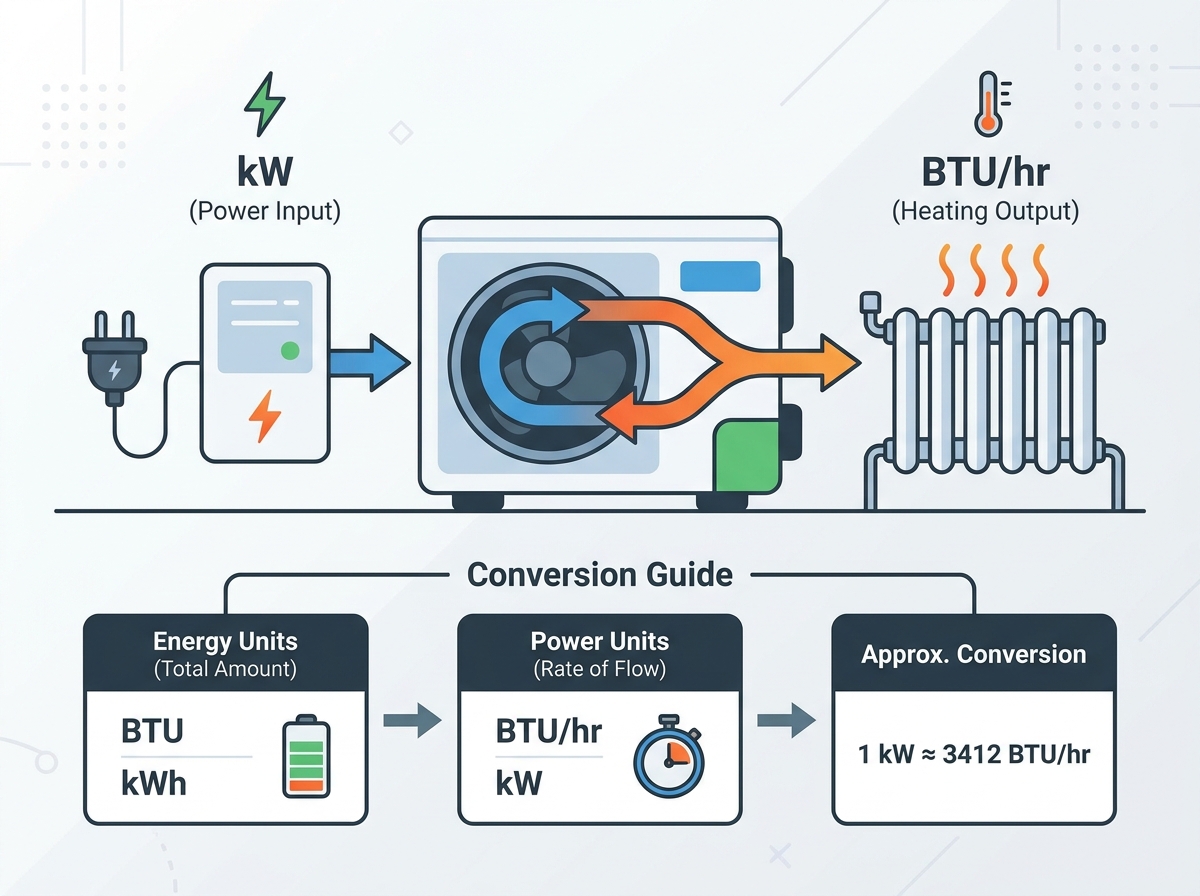
Establishing mathematical constants allows for cross-brand comparison. You cannot compare a domestic unit rated in BTUs against an imported unit rated in thermal kW without doing the math. Use this BTU and kW conversion guide to standardize your evaluations across all manufacturers.
Memorizing these formulas allows field personnel and system designers to quickly verify specifications on the fly. When converting power (rate), use the following multipliers and divisors:
kW to BTU/hr: Multiply kW by 3,412.14 (kW x 3,412.14 = BTU/hr).
BTU/hr to kW: Divide BTU/hr by 3,412.14 (BTU/hr / 3,412.14 = kW).
BTU/hr to Watts: Multiply BTU/hr by 0.293 (BTU/hr x 0.293 = Watts).
When converting energy (total volume), the constant remains the same, but the application shifts to total consumption over time:
kWh to BTU: Multiply kWh by 3,412.14 (kWh x 3,412.14 = BTU).
BTU to kWh: Divide BTU by 3,412.14 (BTU / 3,412.14 = kWh).
To project how much energy a system will use, you must bridge the gap between thermal capacity and electrical draw. First, convert the BTU/hr capacity to electrical kW input using the system's efficiency rating (COP). Next, translate that electrical kW input into projected kWh based on daily run hours (kW x Hours = kWh). This gives you the daily energy footprint of the equipment.
The table below demonstrates how a standard 24,000 BTU/hr (2-ton) system consumes vastly different amounts of electrical energy depending on its operating COP. As the COP increases, the electrical kW draw drops, resulting in lower daily and monthly kWh consumption.
Thermal Capacity (BTU/hr) | Operating COP | Electrical kW Draw | Daily Consumption (10 Hours Run Time) | Monthly Consumption (30 Days) |
|---|---|---|---|---|
24,000 | 2.0 | 3.52 kW | 35.2 kWh | 1,056 kWh |
24,000 | 3.0 | 2.34 kW | 23.4 kWh | 702 kWh |
24,000 | 4.0 | 1.76 kW | 17.6 kWh | 528 kWh |
24,000 | 5.0 | 1.41 kW | 14.1 kWh | 423 kWh |
Numbers on a page mean nothing if they do not translate to physical comfort and reliable operation in the field. You must apply these conversions to the actual mechanical and electrical constraints of the building.
Translate a Manual J load calculation (always in BTU/hr) to a manufacturer's equipment selection software. A Manual J tells you exactly how many BTUs the building gains in the summer and loses in the winter. You then select equipment that matches this number. When evaluating variable-speed inverter compressors, understand minimum and maximum BTU/hr ranges rather than single-stage nominal ratings. An inverter system rated for 36,000 BTU/hr might be capable of ramping down to 9,000 BTU/hr during mild weather or ramping up to 42,000 BTU/hr during extreme conditions. You must look at the entire operating range, not just the nominal sticker number.
Convert kW input to Amps to evaluate existing electrical panel capacity. The formula is Amps = (kW x 1000) / Voltage. For a 240V residential system drawing 4 kW, the calculation is (4 x 1000) / 240, which equals 16.6 Amps. You must then factor in the Minimum Circuit Ampacity (MCA) and Maximum Overcurrent Protection (MOP) listed on the data plate to size the wire and breaker correctly.
Assess the hidden electrical demands of auxiliary heating. High kW auxiliary strip heaters draw massive amounts of power. A 10 kW heat strip draws over 41 Amps on its own. Adding this to the compressor's draw may necessitate a 200-amp service upgrade for the entire building. Failing to calculate this electrical kW load upfront leads to blown budgets and delayed installations.
COP (Coefficient of Performance) is simply Thermal kW Output divided by Electrical kW Input. If a system outputs 10 thermal kW and consumes 2.5 electrical kW, the COP is 4.0. A higher COP directly reduces the kWh required to deliver a specific BTU load. Other metrics like SEER2 (Seasonal Energy Efficiency Ratio) and HSPF2 (Heating Seasonal Performance Factor) attempt to average this efficiency over an entire season, but COP gives you the exact efficiency at a specific operating temperature.
Contractors and designers routinely fall into specific traps when reading submittal data. Avoiding these pitfalls requires strict adherence to the conversion math and a deep understanding of how equipment behaves under stress.
Assuming a 36,000 BTU system delivers 36,000 BTUs at all temperatures is a severe risk. As the outdoor temperature drops, the capacity of an air-source system drops with it. Mitigate this by evaluating Extended Performance Data (EPD) tables to find the actual BTU/hr output and kW input at specific design temperatures. A unit rated for 36,000 BTUs at 47°F might only deliver 22,000 BTUs at 5°F. If your building needs 30,000 BTUs at 5°F, the system is undersized, regardless of what the nameplate says.
Rejecting a highly efficient European unit because the kW rating looks too high mistakes thermal output for electrical draw. A designer might see "12 kW" on a spec sheet and assume the unit requires a massive electrical circuit, not realizing the 12 kW refers to the thermal heating capacity (roughly 41,000 BTU/hr). Mitigate this through strict verification of "Input Power" versus "Rated Capacity" on submittals. Always trace the units back to their source.
Buying excessive BTU/hr capacity leads to short-cycling, poor dehumidification, and higher baseline kW demand. If you install a 60,000 BTU/hr system in a house that only needs 30,000 BTU/hr, the unit will turn on, blast the space with cold air, and shut off before it has a chance to remove humidity from the air. Mitigate this by sizing strictly to the 99% design temperature load and allowing auxiliary heat to cover extreme outlier days. Proper sizing ensures long run cycles, better comfort, and lower electrical demand spikes.
Navigating HVAC procurement requires treating BTU/hr and kW not just as abstract numbers, but as the foundational metrics that dictate both upfront infrastructure requirements and long-term operational efficiency. Prioritize equipment where the manufacturer provides transparent, temperature-specific data for both BTU/hr output and kW input. Discard quotes from contractors who size based on square footage rules-of-thumb rather than precise unit conversions and load calculations.
Request full submittal data and Extended Performance tables for any shortlisted unit to verify capacity at your specific winter design temperature.
Verify the maximum kW draw, including any auxiliary heat strips, against your current electrical panel capacity before signing a contract.
Ensure your contractor uses Manual J load calculations rather than estimates to determine the exact BTU/hr requirement of the building.
Cross-reference all thermal kW ratings on international equipment to BTU/hr to ensure accurate comparisons with domestic models.
A: 1 kW of power equals exactly 3,412.14 BTU/hr. When discussing total energy volume rather than rate, 1 kWh of electrical energy equals 3,412.14 BTUs of thermal energy.
A: Yes, 12,000 BTU/hr is the standard equivalent to 1 Ton of cooling or heating capacity. In metric terms, this translates to roughly 3.52 thermal kW of capacity.
A: You multiply the BTU/hr rating by 0.293 to get the equivalent power in Watts. For example, 10,000 BTU/hr multiplied by 0.293 equals 2,930 Watts.
A: Divide the total BTUs by 3,412.14 to find the equivalent thermal kWh. However, calculating the actual electrical kWh consumed by the equipment requires factoring in the system's Coefficient of Performance (COP).
A: BTU/hr typically denotes the thermal cooling or heating capacity of the equipment in the North American market, while kW denotes the electrical power required from the grid to run the compressor and fan motors.
A: BTU is a fixed measurement of total heat energy volume. BTU/hr is a measurement of power, indicating the speed or rate at which that heat energy is moved into or out of a space.
A: It depends entirely on the system's efficiency. A 24,000 BTU/hr (7.03 thermal kW) system operating with a COP of 3.5 will draw approximately 2.0 electrical kW of power while running.


