


Views: 0 Author: Site Editor Publish Time: 2026-08-12 Origin: Site


When reviewing HVAC specification sheets, you will often find two distinct "kW" values alongside traditional BTU ratings. This dual metric system creates immediate confusion for buyers trying to determine exact power requirements. Misinterpreting thermal output for electrical input leads to inaccurate operating cost projections, undersized electrical panels, and improperly sized equipment. You might look at a data plate and assume a 10 kW thermal rating means the unit pulls 10 kW of electricity. That mistake will result in blown breakers and failed inspections.
Understanding the exact relationship between BTUs, cooling kW, and electrical kW is a mandatory prerequisite for evaluating system efficiency and finalizing a heat pump or air conditioner purchase. By decoding these metrics, you can accurately match thermal loads to your space while ensuring your electrical infrastructure can handle the actual power draw.
Distinct Metrics: "Cooling kW" measures the thermal energy moved by the system, while "Electrical kW" measures the power consumed from the grid to perform that work.
The Golden Ratio: 1 Kilowatt (kW) of thermal energy is strictly equivalent to 3,412.14 British Thermal Units per hour (BTU/hr).
Efficiency Multiplier: A modern heat pump or AC does not generate heat/cold directly; it moves it. Therefore, a system might consume 1 kW of electricity to produce 3 to 4 kW (10,000+ BTUs) of cooling capacity.
Sizing Imperative: Accurate procurement requires matching the thermal load (BTU/Cooling kW) to the space, while matching the electrical load (Electrical kW) to the building's circuit capacity.
BTU stands for British Thermal Unit. It represents the traditional scientific unit of heat energy required to raise the temperature of one pound of liquid water by one degree Fahrenheit. In the HVAC industry, "BTU" is generally used as shorthand for "BTU per hour" (BTU/hr). This metric represents power output or the rate of heat transfer. It directly competes with the kilowatt (kW) as a unit of thermal capacity. When we size ductwork or calculate room loads, we look at BTUs to determine how much heat we need to add or remove from a space every sixty minutes.
Contractors often use BTUs because legacy equipment in North America relies heavily on this measurement. However, as global manufacturing standardizes, metric units appear more frequently on the same data plates. You have to know how to read both to avoid ordering the wrong tonnage for a residential or commercial job.
Industry standards mix Imperial BTUs and metric kW across different global markets and manufacturer specification sheets. Thermal kW defines the rate of heat extraction during cooling or addition during heating. Electrical kW, frequently labeled as "Power Input" or "Active Power," represents the instantaneous active power drawn from the electrical panel. If you confuse the two, you will either undersize the cooling capacity or oversize the electrical circuit.
BTUs and "Tons" dominate US and Canadian markets. The rest of the world standardizes on kW for both thermal and electrical measurements. This regional difference necessitates precise conversion frameworks. When you import equipment or use internationally manufactured units, the nameplate might only list kW. You must convert that thermal kW back to BTUs to match your local load calculations.
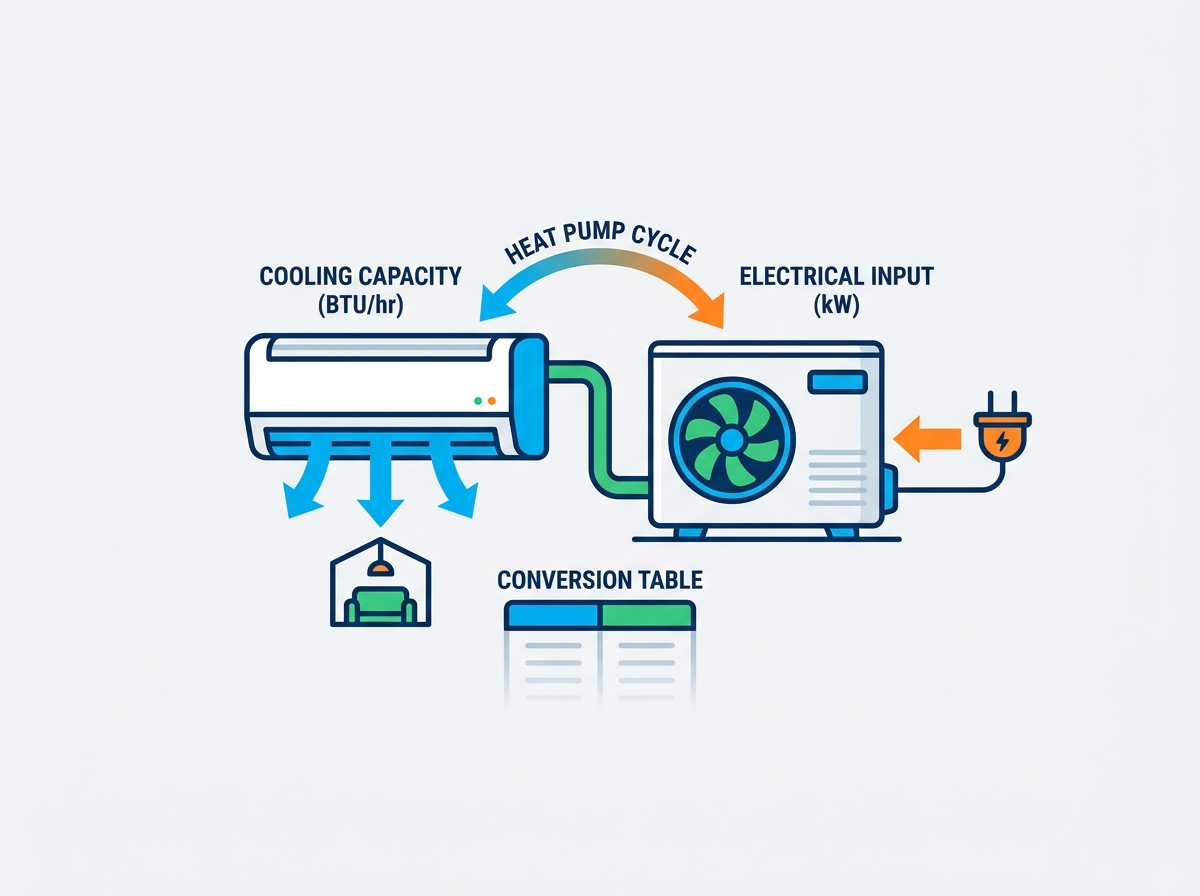
To convert thermal capacity accurately, you must use the correct mathematical formulas. The BTU/hr to kW Thermal Formula is simple. You divide the BTU/hr by 3,412.14 to get the Thermal kW. The Tonnage Formula states that 1 Ton of refrigeration equals 12,000 BTU/hr. That translates to 3.517 kW of cooling capacity. You cannot convert BTU directly to Electrical kW without factoring in the system's efficiency rating, such as EER or COP.
We see apprentices make this mistake constantly. They take a 36,000 BTU unit, divide it by 3,412, get roughly 10.5 kW, and then tell the electrician to wire for a 10.5 kW electrical load. That is completely wrong. The 10.5 kW is the thermal output. The actual electrical draw might only be 3 kW depending on the compressor's efficiency.
This reference maps standard residential and commercial sizes from Imperial to Metric thermal capacity. Use this BTU/hr-to-kW conversion table to quickly cross-reference equipment specs in the field.
BTU/hr (Thermal) | Thermal kW Output | Standard Tonnage | Estimated Electrical kW Input (at 3.0 COP) |
|---|---|---|---|
9,000 | 2.64 | 0.75 | 0.88 |
12,000 | 3.52 | 1.00 | 1.17 |
18,000 | 5.27 | 1.50 | 1.76 |
24,000 | 7.03 | 2.00 | 2.34 |
36,000 | 10.55 | 3.00 | 3.52 |
48,000 | 14.07 | 4.00 | 4.69 |
60,000 | 17.58 | 5.00 | 5.86 |
To find the true electrical draw, you must apply the system's efficiency ratings. Electrical kW (Input) equals Thermal kW (Output) divided by COP. Alternatively, Electrical Watts (Input) equals Cooling Capacity (BTU/hr) divided by EER. These calculations reveal the actual power your panel must supply. Always check the Minimum Circuit Ampacity (MCA) and Maximum Overcurrent Protection (MOP) on the data plate to verify your math before pulling wire.
A heat pump's electrical input shifts between heating and cooling modes, even for a system with the same nominal BTU/hr capacity. Heating mode typically experiences higher electrical loads at low ambient temperatures. This increase occurs due to defrost cycles and auxiliary electric heat strip engagement. When the outdoor coil freezes, the reversing valve switches the unit into cooling mode temporarily to melt the ice, while simultaneously firing electric resistance heaters to keep cold air from blowing into the house.
During cooling mode, the electrical profile focuses on steady-state compressor draw versus peak outdoor temperature demands. The compressor works harder to reject heat when outdoor temperatures soar. This increases the electrical kW input required to maintain the thermal kW output. High head pressure on a 100-degree day will cause the compressor to pull more amps than it would on an 80-degree day.
COP defines the ratio of useful heating or cooling provided to the electrical energy required. A COP of 3.0 means 1 kW of electricity yields 3 kW of thermal energy. EER represents the ratio of output cooling energy in BTU/hr to input electrical energy in Watts at a specific operating point, usually 95°F ambient. Higher numbers mean better efficiency and lower electrical kW draw for the same thermal output.
Modern variable-speed inverter compressors alter power draw based on ambient temperatures. This makes seasonal averages more reliable for operating cost calculations than static kW nameplate data. HSPF2 accounts for seasonal heating power input variations, providing a realistic view of winter performance. SEER2 measures cooling efficiency over a simulated cooling season.
Standard single-stage AC units experience significant electrical kW spikes, known as Locked Rotor Amps (LRA), upon startup. These spikes dim lights and stress electrical components. Inverter-driven units ramp up gradually. They avoid these spikes and maintain a more consistent steady-state thermal output aligned with Rated Load Amps (RLA). This variable capacity allows the unit to match the exact thermal load of the building at any given time.
Rule-of-thumb sizing, such as 20 BTUs per square foot, often leads to inaccurate installations. Rigorous Manual J load calculations provide precise thermal requirements based on insulation, windows, and climate. Matching the thermal load to the building envelope protects the equipment from performance decay. We never guess on sizing. We measure the walls, check the R-value of the attic, and calculate the exact sensible and latent heat loads.
Buying a unit with too high a BTU rating leads to rapid on/off cycles. This short cycling fails to dehumidify the space adequately. The air gets cold fast, but it stays clammy and wet. Short cycling also accelerates compressor wear, reducing the system's lifespan. Compressors pull the most amps during startup. If the unit starts ten times an hour instead of three, it will fail prematurely.
Insufficient thermal capacity results in maximum electrical kW draw without reaching the thermostat setpoint. The system runs continuously, driving up utility bills while failing to maintain comfort. On the hottest days of the year, an undersized unit will simply run 24/7 and the indoor temperature will continue to climb.
Ambient winter temperatures degrade the thermal kW output of a system. Buyers must evaluate the heating capacity at 5°F rather than just relying on the nominal BTU rating to ensure adequate winter performance. A unit rated for 36,000 BTUs at 47°F might only produce 18,000 BTUs at 5°F. You have to look at the extended performance data to know if the unit will actually heat the building during a freeze.
Estimating utility bills requires knowing the actual power draw. Hourly Cost equals Electrical Input (kW) multiplied by the Local Cost per kWh. This calculation provides a realistic projection of monthly expenses. If your unit pulls 3 kW of electricity and your utility charges 15 cents per kWh, it costs 45 cents an hour to run the compressor.
Purchasing a higher-BTU system with a high SEER2 or COP rating requires a larger initial investment. However, the lower electrical kW input reduces monthly operating costs. High-efficiency units use larger coils and variable-speed motors to move the same amount of heat using less electricity. You have to weigh the initial layout against the monthly savings over a fifteen-year lifespan.
To finalize your HVAC procurement strategy, complete a formal Manual J load calculation for your specific building. Verify your electrical panel has sufficient ampacity for the calculated Electrical kW input. Compare the COP and SEER2 ratings of shortlisted units to maximize long-term efficiency.
Perform a Manual J load calculation to determine the exact BTU/hr thermal requirement for your space.
Check the manufacturer's extended performance data to verify the unit meets your heating load at your lowest local winter temperatures.
Calculate the maximum electrical kW input and verify your main breaker panel has the available ampacity to support the load.
Hire a licensed HVAC contractor to install the equipment according to the manufacturer's exact specifications.
A: Cooling kW measures the thermal energy the system moves to heat or cool a space. Electrical kW measures the actual power the system consumes from your electrical panel to perform that work.
A: Divide the BTU/hr rating by 3,412.14. For example, a 12,000 BTU/hr system provides approximately 3.52 kW of thermal capacity.
A: Heat pumps lose thermal efficiency as outdoor temperatures drop. They draw more electrical kW to extract heat from cold air and often engage auxiliary electric heat strips during defrost cycles.
A: Square footage rules of thumb are inaccurate. You should use a Manual J load calculation that accounts for insulation, windows, and local climate to determine the correct BTU requirement.
A: An oversized unit will cool the space too quickly and shut off. This short cycling prevents proper dehumidification and causes excessive wear on the compressor.


